Blog /
The Cambridge dictionary says 'coral' is C2. I don't buy it.
 Ilya K.
·
Ilya K.
·
I looked up the word "coral" in the Cambridge dictionary the other day. Next to the entry, there was a small dark blue badge: C2.
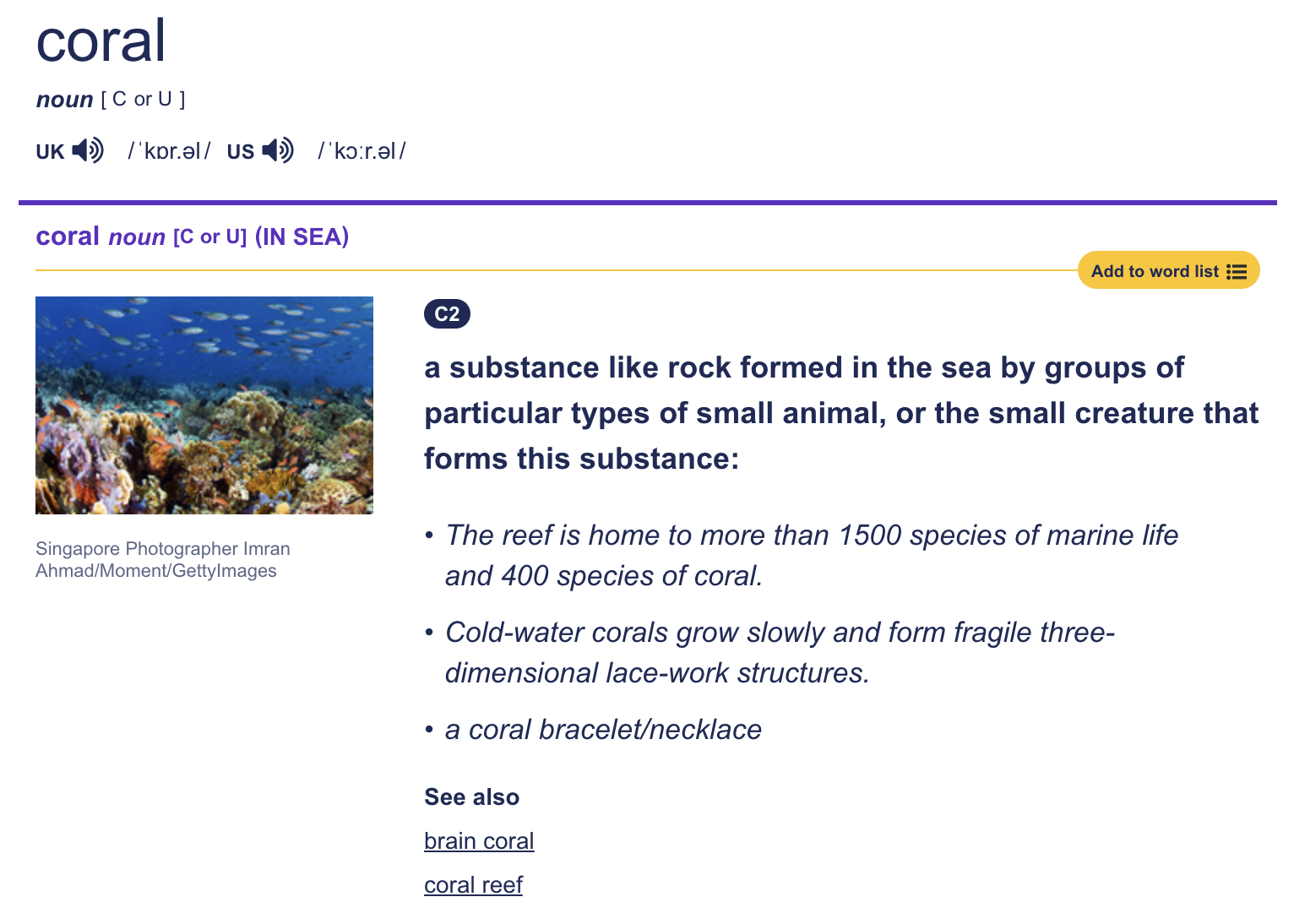
C2 is the top CEFR level. Near-native. The same label they put on words like "ubiquitous" or "paradigm." And here it was, sitting next to a word that any child who has ever seen a picture of the ocean knows.
Coral is the same word almost everywhere
I asked myself how this can be true. Coral is one of the most international words I can think of.
In English, it's coral. In Spanish, coral. In Italian, corallo. In French, corail. In Russian, коралл. In German, Koralle. In Japanese, サンゴ (okay, that one is different, but you get the idea). If you grew up almost anywhere with TV or schoolbooks, you've seen the word. You've seen the thing.
So how does a word like this get the same difficulty label as "vicissitude"?
CEFR labels measure frequency, not difficulty
I think the answer is simple. The label doesn't really say "this word is hard." It says "this word is rare in English text."
Cambridge and other dictionaries build these labels from corpora, big collections of written and spoken English. They count how often a word appears. If "coral" doesn't show up much in everyday English, it gets a high level, even if every learner on Earth already understands it.
But "rare in text" and "hard for the learner" are not the same thing. A word can be rare in newspapers but very easy for you, because:
- It's a cognate in your native language.
- You've seen the object in real life.
- You learned the concept as a child, in any language.
"Tsunami" is probably high level too. So is "yoga," "robot," "pizza," "tornado." International words that millions of learners already know before their first English lesson.
What this means for your study
I keep meeting learners who plan their vocabulary work around CEFR levels. They study "B1 word lists" or "C1 word lists." They feel proud when they finish a level. They feel behind when they don't.
I'm convinced this is the wrong frame. CEFR levels are useful for tests and curriculum design, but they're rough. They don't know what your native language is. They don't know what topics you read about. They don't know that your grandmother is a marine biologist and you've been hearing about coral your whole life.
A label on a dictionary entry is one signal. It is not the truth about whether you should learn the word.
Trust your context, not the label
Here's what I actually do, and what I tell friends to do.
Forget the level. Ask two questions instead:
- Did I see this word recently in something I was reading or listening to? If yes, it matters to you, no matter what level the dictionary calls it.
- Can I already understand it from my own language or from general knowledge? If yes, you don't need to "study" it. You need to use it once or twice and move on.
The best vocabulary list is the one that comes from your real life. Articles you read. Videos you watch. Conversations you had. Words that confused you in a Reddit thread last Tuesday.
That list will not match any C1 or B2 textbook. It will have weird gaps. Some words will be "above your level" and some will be "below your level." That's fine. It's your list.
As I covered in 8 language learning tips that actually work, the moment a word starts to stick is when you've seen it five times in different places. Real places, not a textbook unit.
A small thing
This is one of the reasons we built Wordprism the way we did. You save words from what you're actually reading, with the sentence you saw them in, and you review them later. No level labels. No prebuilt lists. The dictionary can keep telling you "coral" is C2. Your own context will tell you the truth.